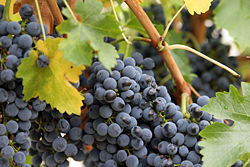
 A grape is the non-climacteric fruit that grows on the perennial and deciduous woody vines of the genus Vitis. Grapes can be eaten raw or used for making jam, juice, jelly, vinegar, wine and grape seed oil.
Grapes grow in clusters of 6 to 300, and can be crimson, black, dark blue, yellow, green and pink. However, "white" grapes are actually green in color, and are evolutionarily derived from the red grape. Mutations in two regulatory genes turn off production of anthocyanin, which is responsible for the color of the red grape.
Most grapes come from cultivars of Vitis vinifera, the European grapevine native to the Mediterranean and Central Asia. Minor amounts of fruit and wine come from American and Asian species such as:
* Vitis labrusca, the North American table and grape juice grapevines, sometimes used for wine. Native to the Eastern United States and Canada.
* Vitis riparia, a wild vine of North America, sometimes used for winemaking and for jam. Native to the entire Eastern U.S. and north to Quebec.
* Vitis rotundifolia, the muscadines, used for jams and wine. Native to the Southeastern United States from Delaware to the Gulf of Mexico.
* Vitis vulpina Frost grape. Native to the United States Midwest east to the coast up through New York.
* Vitis amurensis Most important Asian species.
Seedlessness is a highly desirable subjective quality in table grape selection, and seedless cultivars now make up the overwhelming majority of table grape plantings. Because grapevines are vegetatively propagated by cuttings, the lack of seeds does not present a problem for reproduction. It is, however, an issue for breeders, who must either use a seeded variety as the female parent or rescue embryos early in development using tissue culture techniques.
